Featured

Could the current ‘atypical pneumonia’ outbreak in China be the next deadly epidemic?

On December 31st 2019, China reported to the World Health Organisation (WHO) 44 cases of acute pneumonia that were of an unknown cause; out of these cases, 11 patients were severely ill. As of today, 5th January 2020, this number has risen to 59 with cases being seen in other regions such as Hong Kong. To understand why this is suspicious and alarming, we have to take ourselves back to the SARS (severe acute respiratory syndrome) outbreak of 2003.

The SARS coronavirus outbreak infected 8,098 people worldwide, with 774 of those dying after contracting it. Thankfully, after counter measures were put in place to prevent transmission and contagion, including the use of more than 800 medical experts and chemical testing to identify the cause of the disease, the virus pretty much went down without a proper fight.

When we talk about a viruses pathogenic ability, we refer to two aspects: how transmissible it is from host to host and how deadly it is (mortality rates). The SARS virus didn’t become more than an epidemic because it wasn’t particularly efficient at transmitting between hosts and also killing them. In fact the only reason it managed to spread from China to other countries such as America and Hong Kong, is due to the lack of transparency of the Chinese Government.

In fact, when the outbreak occurred the PRC (Peoples Republic of China) forced a lower coverage of the events by the press and also waited until over 10 people died until they fully reported it to the WHO. As a result, the Chinese health minister, Zhang Wenkang, was sacked and the WHO brought together 196 countries to better improve their ‘capacity to detect, assess, notify and report public health events including outbreaks’. As of 2014, only 1/3 of these countries have achieved this target.

2003’s SARS epidemic showed us that on an international level, we are not ready to logistically communicate with one another in order to deal with another outbreak. The concern with the current ‘atypical pneumonia’ outbreak is that there is a possibility that history is repeating itself and countless lives could be loss due to the same mistakes that have been made in the past. Hopefully this turns out not to be the case.

Sources: https://www.cdc.gov/sars/about/fs-sars.html#outbreak, https://www.who.int/ , https://www.japantimes.co.jp/news/2019/12/31/asia-pacific/science-health-asia-pacific/outbreak-sars-like-pneumonia-investigated-china/ , https://en.wikipedia.org/wiki/Timeline_of_the_SARS_outbreak
Why there is, and isn’t, a cure for HIV

HIV (Human Immunodeficiency Virus) was first identified in the late 50s / early 60s in humans. HIV is a very unique virus as the incubation time is around 8 years and the disease resulting from a sustained infection isn’t actually what kills you. This complex and unique disease took years to develop effective treatment for, and back in the 60s, 70s, 80s, and much of the 90s, it was considered a death sentence; people would fall sick around 8 years after diagnosis, and then die within 2 years after that. Nowadays, there is a cocktail of drugs that can be used to treat HIV called HAART (highly active anti-retroviral therapy), which can allow those infected with HIV to live to within 2 years of their normal life span – an amazing feat of science. Development of drug treatment for HIV is considered one of the greatest feats of molecular medicine having had millions of pounds funnelled into it’s research, which then begs the question, why haven’t we cured it?

To tackle this question, we need to look at the pathogenesis (how the infection leads to disease) of the virus itself. HIV is an infection of a group of white blood cells that make up part of your immune system called T helper cells, which have the really important role of triggering your bodies protective responses when it encounters a dangerous pathogen. HIV can attach to and enter these cells using a couple of receptors found on the outside of the cell; CD4 is the name of the main receptor that the virus will initially grab onto, but once it had a hold on this receptor, it will also grab onto another receptor called CCR5. Once the virus has a hold on both of these receptors found on your T helper cells, only then can it can then invade the cells and cause the damage.

The CCR5 receptor, found on these important cells in your body, has a set structure depending on part of your DNA code, so if that code changes, so will the structure of that receptor. In fact, around 5% of people in the world don’t have a normal code for CCR5, and therefore don’t have the normal structure of the receptor. This means that if a HIV virus particle came across one of these cells, grabbed onto the CD4 receptor, and then tried to grab onto the CCR5 receptor, it wouldn’t be able to, and therefore it wouldn’t be able to get inside the T helper cells and cause any damage. Effectively, these 5% of people are immune to HIV.

These T helper cells are created by part of your body called your bone marrow. The cells in the bone marrow will all be the same, until each cell gets a set of instructions from your body; some of these cells will be told to become T helper cells (with its receptors that HIV uses to get inside), and will be released to protect your body from infections.

Although this all seems a bit confusing at the moment, hang in there. It’s all about to make sense.

Timothy Ray Brown was a man who suffered from a HIV infection, but also suffered from leukaemia, a cancer of the blood cells, and so he needed a bone marrow transplant. After he received his bone marrow transplant, his doctors found that it had in fact cured his HIV infection. But why did this happen?

As it turns out, the person who he received the bone marrow transplant from, was part of that 5% of the population that was immune to HIV. This meant he had the CCR5 receptor in the form where the structure was altered, and HIV particles couldn’t grab onto it and infect the T helper cells. As these cells are made in the bone marrow, once Timothy had received the bone marrow from the immune donor, it started making these T helper immune cells that were immune to HIV in Timothy’s body, meaning he was essentially cured of the HIV infection he had.

Therefore, in practice, you can actually cure HIV, but with over 3.7 million people across the world living with HIV, it would not be physically and logistically possible to give all of these people bone marrow transplants. The good news is, as mentioned earlier, that HIV diagnosis is no longer an immediate death sentence, and those living with the disease can live long, happy lives thanks to the breakthroughs in drug treatment.

Thanks for reading.

What will be the next pandemic?

“There are only three things that are inevitable in this world. Death, taxes, and flu pandemics.” – Dr. Allison McGeer, Former director of infection control at Mount Sinai hospital.

Although my generation has not before experienced what it is like to live through a pandemic prior to COVID-19, it is most likely something we will experience again in the near future. But this notion poses an important question; what type of pathogen will cause the next pandemic, and how may it differ to the one we are experiencing now?

Outbreaks of a particular pathogen are only classified as a pandemic when a certain set of parameters are met, including the inability to track the infection route case by case, when large populations of individuals are effected, and multiple nations and borders are crossed by the infection. A pathogen needs to meet a ‘checklist’ of properties to give it the best chance of reaching the above mentioned parameters, which gives rise to an important concept: not all pathogens will become pandemics.

One of the most defining properties of a pathogen that determines virulence is route of transmission. If you look over the last few centuries, the majority of outbreaks classed as pandemics involved influenza viruses such as H3N2 in 1968 and the infamous H1N1 in 1918, but also occasional occurrences such as Yersinia pestis in 1855. All of these viruses have one thing in common, they have a respiratory route of transmission.

This makes a lot of sense, as one of the easiest ways for pathogens to enter your body is through your respiratory tract. Once inside the respiratory tract, all that needs to happen is for the pathogen to withstand the environment that’s trying to get rid of it, replicate, and then be spread to other hosts through aerosolised droplets. Now consider that someone infected coughs on a crowded train; you’re looking at a lot of people who are at risk of being infected.

There is however an exception to this trend – the cholera pandemic of 1817-1824. This is a pathogen that is not transmitted through coughing, sneezing, etc, but instead is transmitted through faeces; in particular this pandemic started through contamination of water with infected poo. Nowadays, most people don’t usually die from a cholera infection due to the advancement in water treatment, disease treatment, and, for now, the effectiveness of antibiotics, but back in the 18th century the outbreak was thought to have killed around 2.5 million people.

So to answer the question: “What will be the next pandemic?”- no one really knows. Outside of it being highly likely to be caused by another Influenza or Coronavirus, there is still a very real danger of non-respiratory pathogens causing a devastating outbreak. On top of this, spread of urbanisation and a dangerously increasing global population size means that more areas around the world are being accessed and colonised by humans when they were previously untouched, increasing the risk of spillover events of new pathogens we have never even seen before.

Therefore, the most important question isn’t necessarily what the next pandemic will be, but when will the next pandemic come, and what can we do to prevent it?

Thanks for reading.

COVID-19: A warning for the inevitable next pandemic

It’s been 570 days since I had last posted on this blog, and therefore 570 days since my warning of a potentially looming pandemic.

Back on the 5th of January, 2020, I wrote my first blog post about reports of an ‘atypical pneumonia’ originating from China, and how the situation at the time could potentially unfold into a pandemic. The takeaway from that article in short, concerned the previous failings of the Chinese government in the handling of the early 2000’s SARS-CoV-1 outbreak, and how if these mistakes were repeated, the consequences could be horrendous.

Without going into detail in this post, there are a plethora of reasons as to why we are in the situation that we are in now and an equal amount of reasons as to how this could have been avoided. Instead of talking about the past, in this post I aim to look forward and think about some of the implications of this pandemic on the future of the human race; this is the biggest and only warning sign that there is for the governments of the world to understand that a society crumbling, civilisation destroying, economy crippling pandemic is almost guaranteed, and, above all else, we are not prepared for it.

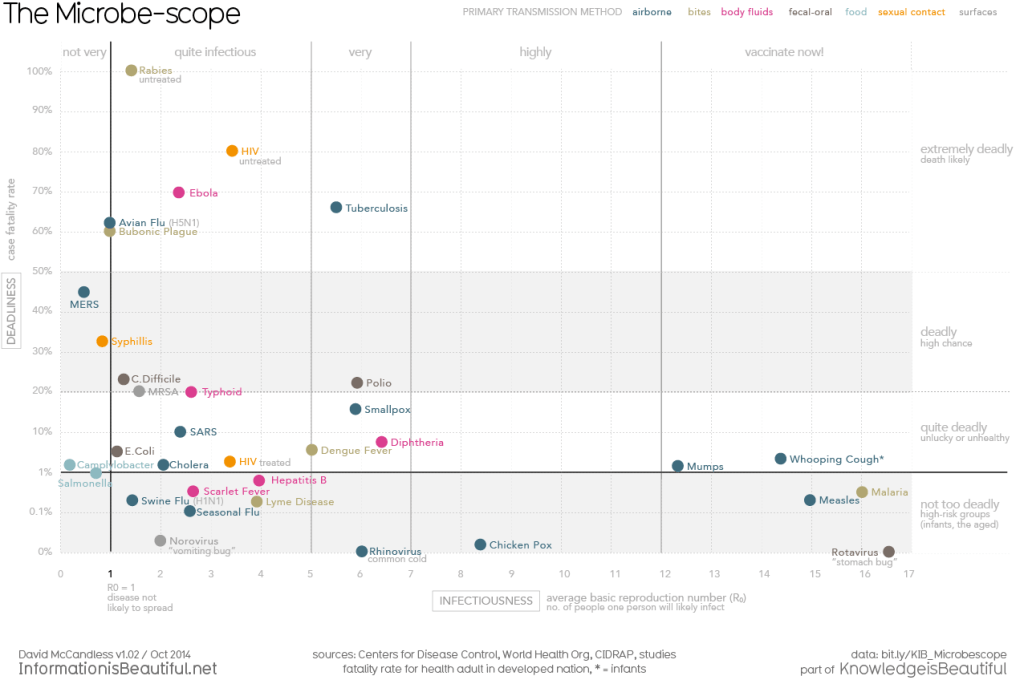
https://www.vox.com/xpress/2014/10/17/6993851/diseases-deadly-infectious-reproduction-information-beautiful

The chart above visualises the most important aspects defining how dangerous an infectious agent is and shows that this is defined by an interaction between the ability of the agent to infect between and within hosts, along with how deadly to a host it is once it has infected it. Effectively, the more dangerous the agents lie towards the top right side of the chart, and the less dangerous it is, its position will be further towards the bottom left.

If we consider SARS (which includes SARS-CoV-2, the causative pathogen of COVID-19), this group of viruses is considered quite infectious and quite deadly, but in relative terms it sits at the end of the scale that includes the less dangerous infectious agents. Yet when we think back to the last year, and the implications the novel SARS-CoV-2 virus has had, you can only imagine the devastation that a virus, bacteria, or other pathogen (most likely a novel influenza) could cause in the same circumstances. Unfortunately we would be looking at 10s of millions more deaths, collapse of healthcare systems and the potential collapse of governments themselves.

Worlds leaders, governments and external organisations MUST come together at the end of this pandemic, and come up with a detailed but simple and uniform structure to tackle pandemics when they inevitably arise again. SARS-CoV-2 from an epidemiological, political and logistical standpoint has taught us an incredible amount about how ready we are to handle a more dangerous and devastating emerging pandemic and unfortunately, the results of those teachings are bleak.

There is still plenty of time to prepare ourselves and come up with a plan from a political standpoint to prevent this happening again, but we can only hope that becomes a reality in order to preserve our way of life.

Thanks for reading.

My first post

My name is Adam and I am currently studying biochemistry in my first year of university. I’m going to use this blog to write about some of the topics that I encounter that interest me so that I can better understand and research them. I am primarily interested in viruses and pathogens but also the social side of the science, such as implications of epidemics and how climate change and other factors effect outbreaks.

Despite this, I wont limit my posts to these topics and hopefully by doing this I can improve my writing skills along with my knowledge.

Design a site like this with WordPress.com
Get started